
Linear regression vector form
This article covers the generalization to a vector form of what we did in the last article. That means coming back from only one observation xi (of one car) to the whole feature matrix X.
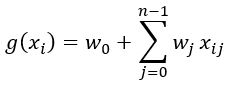
Looking at the last part of this formula we see the dot product (vector-vector multiplication). g(xi) = w0 + xiTw
Let’s implement again the dot product (vector-vector multiplication)
def dot(xi, w):
    n = len(xi)

    res = 0.0
    for j in range(n):
        res = res + xi[j] * w[j]

    return res
Based on that the implementation of the linear_regression function could look like:
def linear_regression(xi):
    return w0 + dot(xi, w)
To make the last equation more simple, we can imagine there is one more feature xi0, that is always equal to 1.
g(xi) = w0 + xiTw -> g(xi) = w0xi0 + xiTw
That means vector w becomes a n+1 dimensional vector:
- w = [w0, w1, w2, … wn]
- xi = [xi0, xi1, xi2, …, xin] = [1, xi1, xi2, …, xin]
- wTxi = xiTw = w0 + …
That means we can use the dot product for the entire regression.
xi = [138, 24, 1385]
w0 = 7.17
w = [0.01, 0.04, 0.002]

# adding w0 to the vector w
w_new = [w0] + w
w_new
# Output: [7.17, 0.01, 0.04, 0.002]

xi
# Output: [138, 24, 1385]
The updated code for linear_regression function looks now like
def linear_regression(xi):
    xi = [1] + xi
    return dot(xi, w_new)

linear_regression(xi)
# Output: 12.280000000000001
Having done this, let’s go back to thinking about all the examples together.
X is a m x (n+1) dimensional matrix (with m rows and n+1 columns)
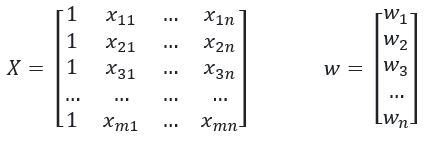
What we have to do here, for each row of X we multiply this row with the vector w. This vector contains our predictions, therefor we call it ypred.

To sum up. What we need to do to get our model g is a matrix vector multiplication between X and w.
w0 = 7.17
w = [0.01, 0.04, 0.002]
w_new = [w0] + w

x1  = [1, 148, 24, 1385]
x2  = [1, 132, 25, 2031]
x10 = [1, 453, 11, 86]

# X becomes a list of lists
X = [x1, x2, x10]
X
# Output: [[1, 148, 24, 1385], [1, 132, 25, 2031], [1, 453, 11, 86]]

# This turns the list of lists into a matrix
X = np.array(X)
X
# Output:
# array([[   1,  148,   24, 1385],
#              [   1,  132,   25, 2031],
#              [   1,  453,   11,   86]])

# Now we have predictions, so for each car we have a price for this car
y = X.dot(w_new)

# shortcut to not do -1 manually to get the real $ price
np.expm1(y)
# Output: array([237992.82334859, 768348.51018973, 222347.22211011])
The next snippet shows the implementation of the adapted linear_regression function
def linear_regression(X):
    return X.dot(w_new)

y = linear_regression(X)
np.expm1(y)
# Output: array([237992.82334859, 768348.51018973, 222347.22211011])
Maybe you wonder where the w_new vector comes from. That’s the topic of the next article.
 knowMLedge.com